
Offering: Community Supported Literature (CSL) Shares
A lengthy confession on the sincerity of words, authors, generosity, poems, writing, and publishing.

I’ve been living this lyric of John Gorka’s my whole life: “You ask the world / And the world says, no / It’s the world’s refrain / Mine says, go.”
The path to my Community Supported Literature Shares (CSL) program is circuitous. I think you’ll enjoy the twists, turns, and reflections along the way.
I crave a meandering trout stream, eddies, undercut banks, and riffles; some believe I take my fly rods for walks more than I fish. When I venture out though, I feel in the midst of the catch of my lifetime. Then December arrives, and I get trapped in winter shadows whilst they stretch across fresh snow between leafless trunks of trees, the world silent, bitter blacks-and-whites, narrated by pileated woodpeckers and a pair of distant barred owls. This particular Substack is a gesture of thanks—an offering to words, writing, and books. In praise of community and region, readers and writers.
When I think of the many writers I’ve met in person and what they’ve meant to me, there are four who come to mind most deeply—Barry Lopez, William Stafford, Terry Tempest Williams, and Gary Snyder.1 Do I believe any one of them are aware of their influence, recall ever meeting me, unlikely? Each involved brief encounters, borderline accidental.
In 1984, I entered a “lecture” hall in Iowa City, told I’d enjoy the speaker, because I liked Thoreau’s Walden. I arrived to hear Barry Lopez, who had authored a book entitled Of Wolves and Men. He spoke about giant landmarks and the language used in vast Arctic landscapes, of geese lifting in unison, of winter counts, but mostly he spoke with a passion I hadn’t heard an adult use before. What he shared and how he shared his fascination with the natural world changed the course of my life from the very moment I left the room that day. He did to me what he said wolves did to him: “The wolf exerts a powerful influence on the human imagination. It takes your stare and turns it back on you.” I went to a couple of his book signings over the years, exchanged a few words and handshakes. I never tired of his tone of voice, use of language, and the environment. I sent him every book, and reviews of his books, I wrote. Each time he sent me a short, eloquently worded postcard, encouraging me to keep up the good work. We exchanged short notes like this about twenty-five years until he passed away near the end of 2020. I still feel grateful he ever took time to reply to me, and cherish the world he opened my senses to.
Years and years ago, now out of print, Northern Lights journal hosted an event in Missoula, Montana, honoring the poet W.S. Merwin. At the time, a young Rick Bass and Terry Tempest Williams were also featured. During a breakout session, I went and listened to Terry Tempest Williams. Her book Coyote’s Canyon had recently come out and captured my imagination. After she finished talking, to my surprise, she walked over to me and exclaimed she’d admired my attentiveness. Was that even a thing? I told her I enjoyed what she’d been talking about, we talked a bit; I mentioned I was having a go at some writing, and she asked for a sample. I gave her an odd “myth” I was working on—words mixed with simple drawings—I’d entitled The Burning of Knuckle Bruised Confusion. A couple months later, she sent an encouraging note, expressing I was onto something, perhaps a new sort of nature-based myth. That day in Missoula, though, I have to admit, I was more interested in getting out of the conference and finding trout on Rock Creek, and didn’t spend much time speaking with her; however, her generosity and feedback took me by surprise and inspired me more than she will ever know. The day her note arrived in the mail, landlocked as I was in Kansas at the time, I felt a renewed sense of hope in what I was doing. Another’s time is truly a gift.
In 1987, I chanced into a poetry reading at a library in Pullman, Washington, by a poet I had never heard of, William Stafford. He was a calm and soothing reader. He talked, particularly about a poem of his, entitled Ask Me. He explained the power of words could change a life if you were lucky, both as a writer and a reader. He told how a dishwasher in Bodega Bay, California, recognized him one evening while he was eating dinner on a dock. He’d come out to thank him for writing Ask Me. Said, honest to god, the poem had changed his life, made him see the world more clearly, listen longer, and slow down. In fact, he and his “now wife” used to read and re-read the poem to each other, slower and slower, each and every word, full of sound. And so now, Stafford read the poem as slowly as he could, to us. I listened, charmed. The pace was superb, maybe even over too soon. Poetry and words, I understood, right then and there, weren’t really just for lovers, or funerals, or ivory towers, but for the living, for those trying the very hardest to make sense of being alive. Every time I read the final line of Ask Me, I nod my head, “What the river says, that is what I say.”
The fourth author is a roundabout one, I admit. I frequently recall the rousing start of Allen Ginsberg’s Howl, “I saw the best minds of my generation destroyed by madness,” and marvel the book was published by Lawrence Ferlinghetti’s City Lights small-press pocket-book series. Yet this isn’t the full roundabout; the tie is that I’ve been a Jack Kerouac junkie since reading On The Road. When I found out Kerouac also wrote The Dharma Bums and that Gary Snyder was the inspiration for the book’s character Japhy Ryder, I was more or less floored. I was equally interested in the beats as I was in the world of environmental writing—Wendell Berry, Aldo Leopold, Gretel Ehrlich, Sigurd Olson, etc. I had read Snyder’s Turtle Island. In fact, when I sent out my first publication, Sycamore Roots, I had read the essays in his Practice of the Wild four or five times. After mailing out Sycamore Roots, as if by miracle, Snyder sent me a $5 bill to subscribe. After that, we exchanged a few notes. As with the other authors, he encouraged me to push ahead with my ideas. I finally met him, very briefly, in Ames, Iowa. I introduced myself, and he said he recognized my name. Really? We spoke for maybe five minutes. A small thing in his world, but genuine inspiration in mine. This, and the other brief author encounters I’ve had, made me feel I belonged where I’ve always hoped I might end up.
Success is really about understanding the give-and-take of generosity and hope, and then having the courage and persistence to enable them. Sure, part of success is just showing up. Part is believing in others—in the talent of authors. What do I mean? Knowing and appreciating good writing when I read it.
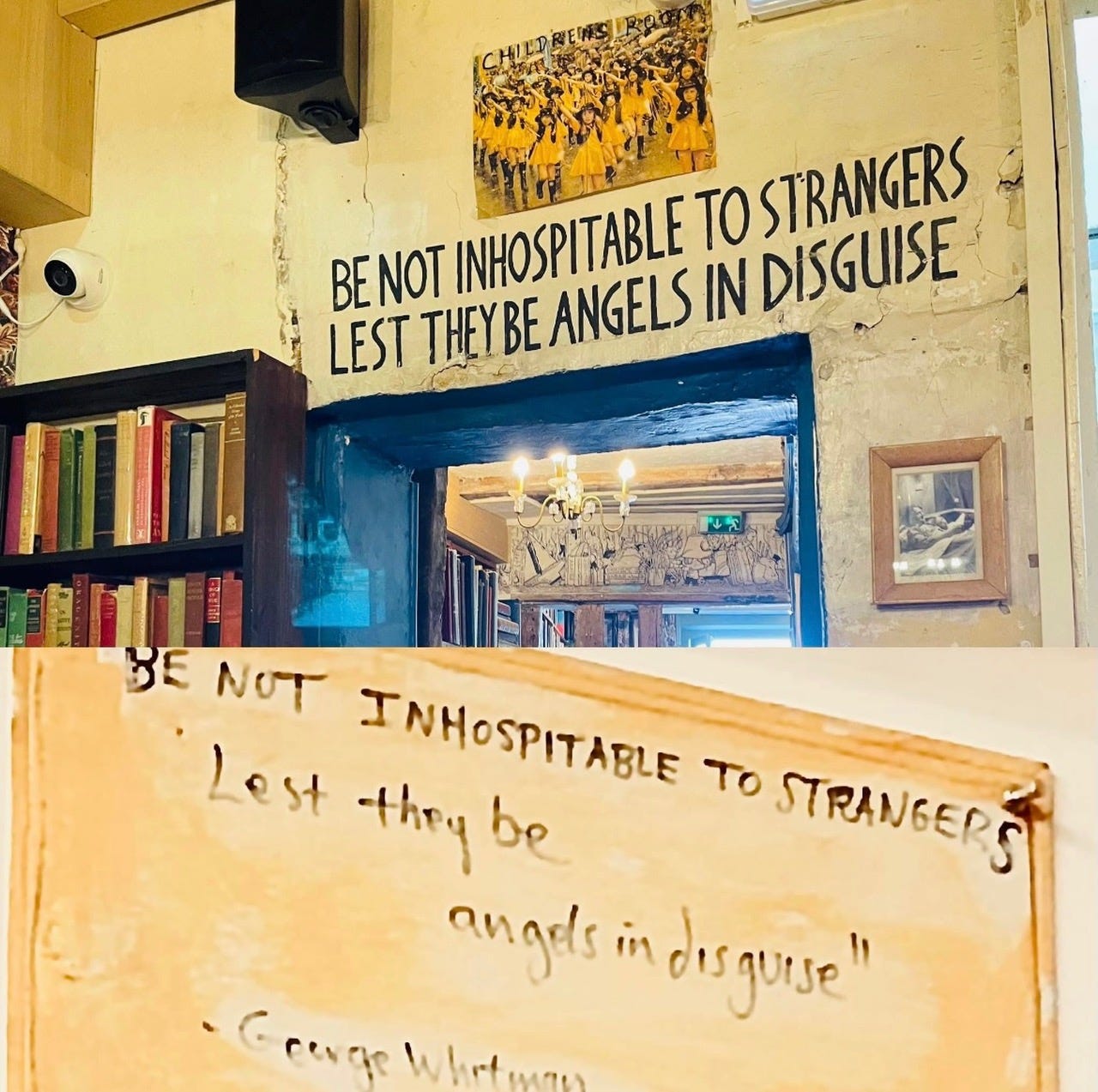
I’ve felt the power of words rush through me many times. I’ll give you an odd example—one sentence in two different spots. The first was inside City Lights bookstore in San Francisco. I noticed, above a door, “Be Not Inhospitable To Strangers Lest They Be Angels In Disguise.” Not complex, but the words and the setting made an impact on me. Then, by surprise, I spotted them again in Paris at Shakespeare & Co., and felt the same. Just words, I know, but surrounded by books and words, so far from home, I felt the power of words in me again.2
I’ve been lucky to live in such a way that words are vital to who I am, are illuminated in my mind. I meet authors at the right times in their lives, and then share remarkable books with readers. As if walking in Wonderland and chancing up on the Cheshire Cat. The ingredients of contagious magic right before me, so that I cast the literary arts in such a way to better understand how we can best live, right here, in the Midwest.
As I write this, it’s hard to believe I started my press during my 20s and I’m now in my 60s.3 Considering I’ve never been trained in business, marketing, publishing, design, editing, economics, publicity, social media, you name it,4 it’s even more strange. I like to believe what I know has come through energy, persistence, observation, listening closely, making mistakes, and motivation. Jim Harrison said something along the lines of, “It gradually occurred to me that it’s not people’s problems that interest me, but their solutions to their problems that interest me.” This has been my crystal ball. I’ve done what I’ve had to do, at a pace I could sustain.5
First and foremost, authors have trusted me. Without this, there would be nothing. Publishing has meant finding and sharing their words. I’ve done this by foraging through submissions, conversations, trusting my curiosity, and, I suppose, sacrificing my wish to be a writer myself. But, as the saying goes, “that’s why they call it work.” There was a point at which the thing I cared about most became the way I needed to make a living. This threshold was not as easy as I’d thought. Looking back, I quote the poem Ask Me again: “Some time when the river is ice ask me / mistakes I have made.”
What have I tried to do best? Be as honest and sincere as I could be. What do I mean? To do for authors what I would want a publisher to do for me. Have I always done this well? No. Are some upset with me? I’m sure they are. Have I told every single author that I can only do so much for them? Yes. Have they always agreed to this limitation from the beginning? Yes. Sadly, I have to say NO more in my life than I say YES. No one is ever completely happy. I could sell 10,000 copies of a book, and the author would almost instantly wonder why I didn’t sell 11,000. I could accept 15 books a year, and someone would still be upset that I didn’t take just one more, even though I’d have literally no time, energy, or money to help them. I get lots of things wrong; sometimes, I know pretty quickly I’ve made a mistake, but when things go right, there is nothing better. My goal is never to have a book fail. But so it goes, right? Some do. Some don’t. The way is easy, strive hard.
I’m finally going to explain what all this has to do with my Community Supported Literature Share (CSL) program and what signing up on Substack means:
I publish books bigger publishers won’t: Big publishers have brand managers, distribution deals, and shareholders to answer to. They won’t put their name on certain titles no matter how important the story is. I make decisions based on what needs to be said, not what’s safe for a corporate image. Your CSL share funds publishing that prioritizes truth over marketability. I doubt a larger publisher would have titles such as Art Cullen’s We Crapped In Our Nest, or Chris Jones’s The Swine Republic.
You’re investing in literature that explores and explains the Midwest: These aren’t books that get rejected by New York City—they are books they would not even consider. I publish writers and topics which reflect what’s actually happening in rural environments and Midwest communities, voices and perspectives being ignored by national publishers. I believe our so-called flyover territory is an enlightened region, full of reality-based ideas and insights worth sharing and learning from. I believe the truth is here, not on the coasts.
I encourage authors to say what they actually mean: When writers work with me, they’re not editing themselves through the lens of focus groups and acquisitions committees. They write their real story—raw, regional, and honest—because they know I won’t flinch. These voices exist because I actively promote courage instead of self-censorship. I don’t worry about word counts. I tell authors all the time, “Use however many words you need to best say what you have to say.”
I’m a “shop local” and a “read local” movement: Just like Community Supported Agriculture (CSA) connects you directly to farmers growing real food, a CSL connects you directly to a local publisher. The same values that drive people to support local businesses, farmers’ markets, and regional entrepreneurship apply to books. When you buy from chains or online retailers, the money goes to massive corporations. Your CSL share supports this independent Midwest business directly and its authors. In some cases, a local indie bookseller.
You get to see yourself and your place in literature: People enjoy movies when they recognize themselves and their communities. Reading about where you actually live—the towns, landscapes, and struggles of the Midwest—is exciting in the same way. These books are about agriculture sometimes, yes, but also rivers, small-town life, birds, seasons, and the real stories happening in places that national publishers treat as flyover country. You get novels, poetry, and nonfiction that reflect your world, proof we exist, and reflect what we care about most. These days, there’s a tension, too, in Iowa at least—blue lives trying to figure out life in a red state.
You get 8-12 books delivered: Like a CSA farm share, you’re pre-funding the work and getting a full harvest at the end of the year. All our books get made based on literary merit rather than corporate sales projections. You’re discovering new writers and subjects you might not have chosen on your own. At the end of the year, meaning right about now, you’ll be sent all the books we’ve worked on in 2025. I’d also point out: If you want to support this work but don’t need the books yourself, your annual share can go to a local library, school, writing group, community center, senior center, or even a Little Free Library in your neighborhood.
You get Substack columns all year on writing and publishing: Throughout the year, your CSL Substack subscription includes (much shorter) columns with writing advice and thoughts on publishing, drawing on decades of hands-on experience. I try to surprise and share ideas that differ from other publishers. In my opinion, no one needs to read another post on query letters, about showing not telling, or on how to craft an opening paragraph. I believe in using stories to encourage writing, and I like drawing on examples from my own life to offer writing tips. I also introduce any interns I have and pass along news that seems relevant throughout the year.
You’re supporting 35+ years of independent publishing: As I mentioned earlier, this marks the start of year thirty-six. Your subscription keeps this entrepreneurial operation alive and proves that alternatives to corporate consolidation can thrive year after year. If you want independent books, independent voices, news, and journalism, it takes a community, not just likes on social media platforms.
In the end, it’s the same spirit as Eat Local & Shop Local, except it’s Write Local & Read Local. The more people who join, the better. In the words of Red Green, “We’re all in this together.”
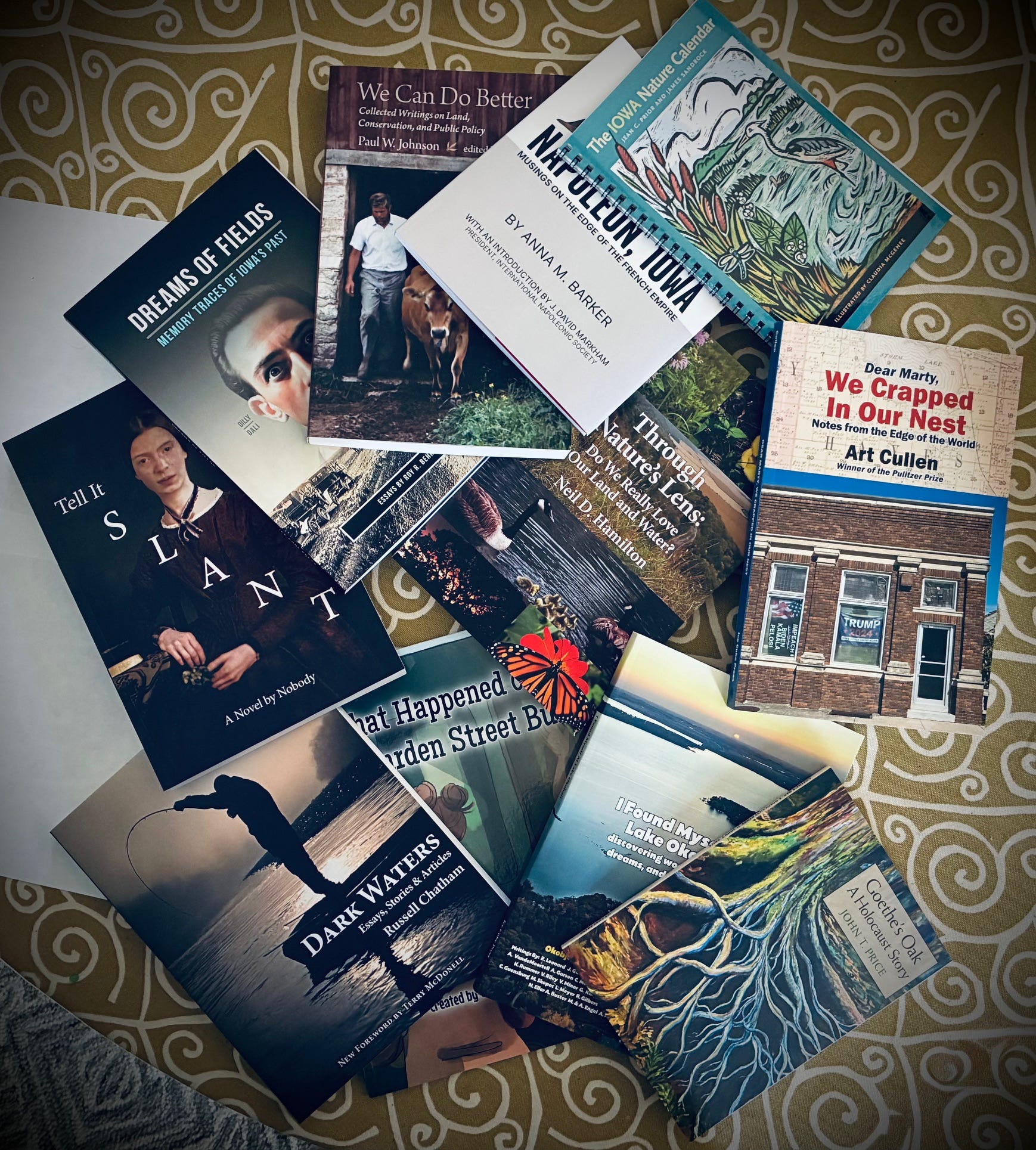
I’m a member of the Iowa Writers Collaborative Roundup a healthy group of mostly Iowa writers doing the best they can to bring good words to the masses.
I’d always wanted a 5th to be Jim Harrison, but I only encountered him once, in 2013. I tried to break the ice with him outside a conference hotel after he’d spoken at a booksellers’ award ceremony one time. I moseyed over, sat beside him, and mentioned Lake Leelanau grapes and wine but, in a couple of minutes, before he could even finish his cigarette, he was whisked away by his “people.” They seemed perturbed with me. He’d acted surprised I knew anything about the area and grapes. Mind-reading, sure, but both of us seemed disappointed at the abruptness of his being pulled away, especially when I’d mentioned Bernie Rink, the pioneer of Boskydel vineyards, but alas, it was not to be.
I’d love to hear of other places folks may have seen these words.
One rainy day in November 1991, I took off at night in Lawrence, Kansas, and mailed what would be my first Ice Cube Press piece of printed material. Amongst the first few people to pay me for what I did were William Kitteridge, Gary Snyder, Gene Logsdon, and Wes Jackson. I like to call this newsletter and these first responders my “real-life MFA.”
When I was younger, I did have a lot of people say, “Don’t get smart with me.” Maybe that was a good thing after all?
I heard Scott Galloway say the smartest thing he ever did was be born a white male in the 1960s. Well, I can’t disagree with that.
Thank you Steve for this very personal essay and ask. You are an inspiration. You’ve given me several things to think about and work on with my journey to record my life.
Thanks for sharing your personal history of inspiration from some great writers (the four you highlighted and the others you mentioned). Most of these also have been impportant inspiration for me (I'd of course add few more - Edward Abby off the top of my head). I hadn't heard of the CSL - something to think about.