
Impossibly Invisible: Star Trees & Onion Tears
Hiding, seeking, and putting in the time for luck.

“The eye sees only what the mind is prepared to comprehend.”―Robertson Davies
I’ll start this way. Wendell Berry wrote: “There’s an important difference between telling the right story and telling the story right.” Good intentions aren’t everything, but they are significant. Being “right” has limitations—meaning: being right doesn’t mean you necessarily ever get anything done. In a similar way, we know figuring out reality, taken far enough, tips into fiction. Albert Camus hinted: “science that was to teach me everything ends up in a hypothesis.” A leap of faith is not a quip, but a query. Do you stay a course—following hints and facts to the unknown?
A trail of tears runs wet from lies and unfaithful gestures. When chopping fresh yellow onions, tears come out of me. The tears aren’t dramatic; they’re real. In many ways, the world could use an onion-flushing, a scrubbing of our tear ducts, a cleansing of our motivations glutted with silt and coarseness.
Truth is elusive as a Red-tail hawk twists out of view in the sky. Each step forward feels like the title to Jonathan Safran Foer’s book, Extremely Loud & Incredibly Close. Explosions in the ear. Sudden, helpless gasps which stop the breath and silence the ears. There are normally many truths at once. One convenient, others difficult. The comfortable one doesn’t account for much—a sort of glittery makeup on the outside—a dog is barking. What we crave is why. Why is the dog barking? I discovered an explanation of useful truth versus dramatic truth in The Score, by C. Thi Nguyen:
“We must assume there’s a gap between the methods of science that lead to good science and the methods that lead to more publications. Second, more publications lead to higher prestige and better jobs. Third, young scientists are more likely to imitate the scientists with the higher job status.”
This encapsulates a dangerous loop. Status replacing knowledge, the easy path dressed up as the harder one. We arrive, again, at telling the right story versus telling the story right. Makes me feel like I rubbed my eyes with the juice of onions.

“Reality” is tricky, like a rabbit pulled out of a hat. Looks can be deceiving. What’s true today is fool’s gold tomorrow—sometimes hidden, sometimes camouflaged. Inside the cottonwood tree are stars. When I first discovered this, I was surprised. Try it yourself, crack a small branch, and inside you’ll uncover a five-pointed star. When I spot a lone cottonwood in the middle of Kansas, for instance, I recognize persistence. A suspension of the impossible. A cradle for the holy. An actual galaxy.
People tell me, “You don’t look like a publisher.” Most things don’t announce what they are hiding. What's inside the onion we can't know, and what's inside the cottonwood we didn't see. At first glance, a Cottonwood looks like most trees on a riverbank—rough bark, cotton-heavy air in June, roots hunting water. Who knows where else you’ll find a five-pointed star. Maybe a round stone you find on a creekside will be a geode, splashed with color inside.
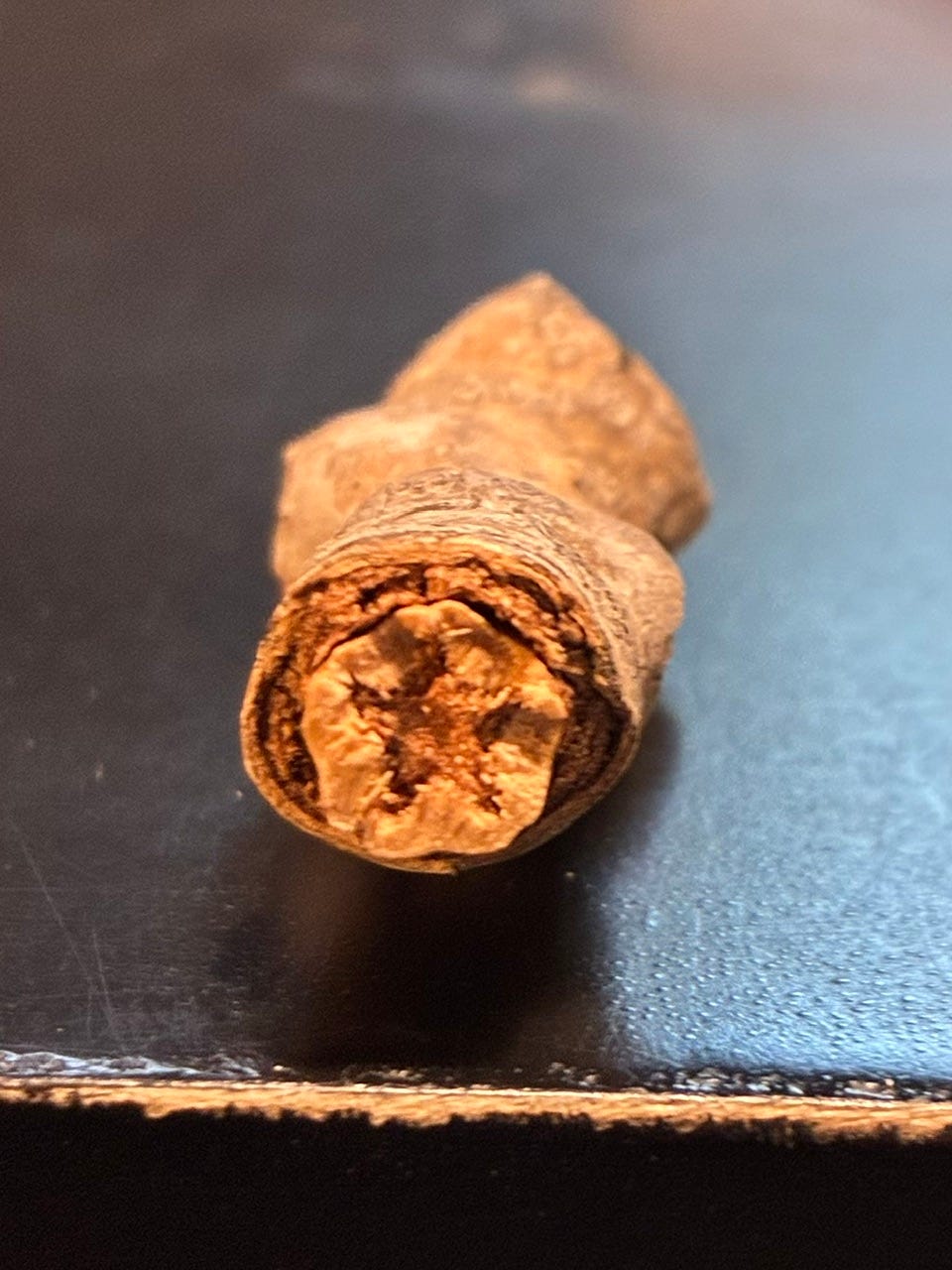
There were a couple of behemoth Cottonwoods along the Kaw River when I lived in North Lawrence, Kansas. Each caused me to slow down and think. Something about being by them, touching them, provided a healing touch. As if they were giant acupuncture needles slipped into my uncertain soul, displacing my fears and doubts about the future with natural courage. Not like turquoise, but they felt as bright and bold. For a year or two, I developed an empathy with their struggles to grow, similar to finding my own place in this world. What was the exact feeling? I’m not sure, but I was on a journey to discover the extra part you can add to ordinary. I was searching the earth for hidden stars. This coincided with the beginning of my publishing life.

People assume that creativity and writing get easier over time, this is rarely true. In fact, writing is a way of narrowing your choices; having too much freedom and time usually doesn’t work. A bit like fitness, what was hard gets easier, but that’s because you’re in better shape, so you rise to a new level of challenge and so on. There’s this belief that writing, or creativity, is luck and it’s some passion which clicks on a whim. The secret recipe is putting in 10,000 hours and it’s telling a story the right way as much as telling the right story. There’s a difference between good writing and how many views you get. See Nguyen's quote above again. Being told you’re wrong and not minding is part of the path some call luck. Noticing the invisible when others think you’re just seeing things.
If you are never completely alone with your own thoughts, you will never come to any valuable realizations. The idea that some people may not have their very own thoughts and opinions seems sad and unbelievable to me. Every yellow brick road is paved with failure and fantasy. Like bread dough, slow kneading and time reveal how sour can be baked into something we enjoy right out of the oven. Some days, I stand in a spring creek and understand the water has flowed straight from the Milky Way. This didn’t happen because fortune randomly smiled, but because I kept showing up until the water felt like home.
The hard thing to do is usually the right thing to do, which means to write well is to go inside, to find what makes an onion cause tears, to see the stars inside the cottonwood. To examine closely and not take shortcuts. Good writing takes time and increasingly more and more effort. Try to explode auras. Not as flashes of light, but to recognize stars and the variety of light already all around us.
I’m a member of the Iowa Writers Collaborative Roundup Sharing comma splices here and there along with all the others.
Thank you. I find myself at a crossroads. I hold a Degree in a Science that I never pursued. I have 53 years in a career that I am recognized as an expert in but have no interest in continuing. You have provided thoughts that light up unexplored possibilities. I am not ready to do as Townes Van Zant same about. In fact it was the first song that he was ever known for. “Hangin’ Around Waitin’ to Die” . I’ve been doing that. It takes too long. It boring. I will be in Iowa in a Month. I may take a long walk down Otter Creek with an eye out for cottonwoods.
Steve, have you read The Cottonwood Tree: An American Champion by Kathleen Cain? I think her publisher went under, but it's a brilliant and poetically crafted book, singing the history and the humble magic of the Cottonwood. I know you would enjoy it.